
Services
Insurance ClaimsBased in Fort Worth, TX
Help through a roof claim, from the first inspection to the approved scope.
Get a Free Estimate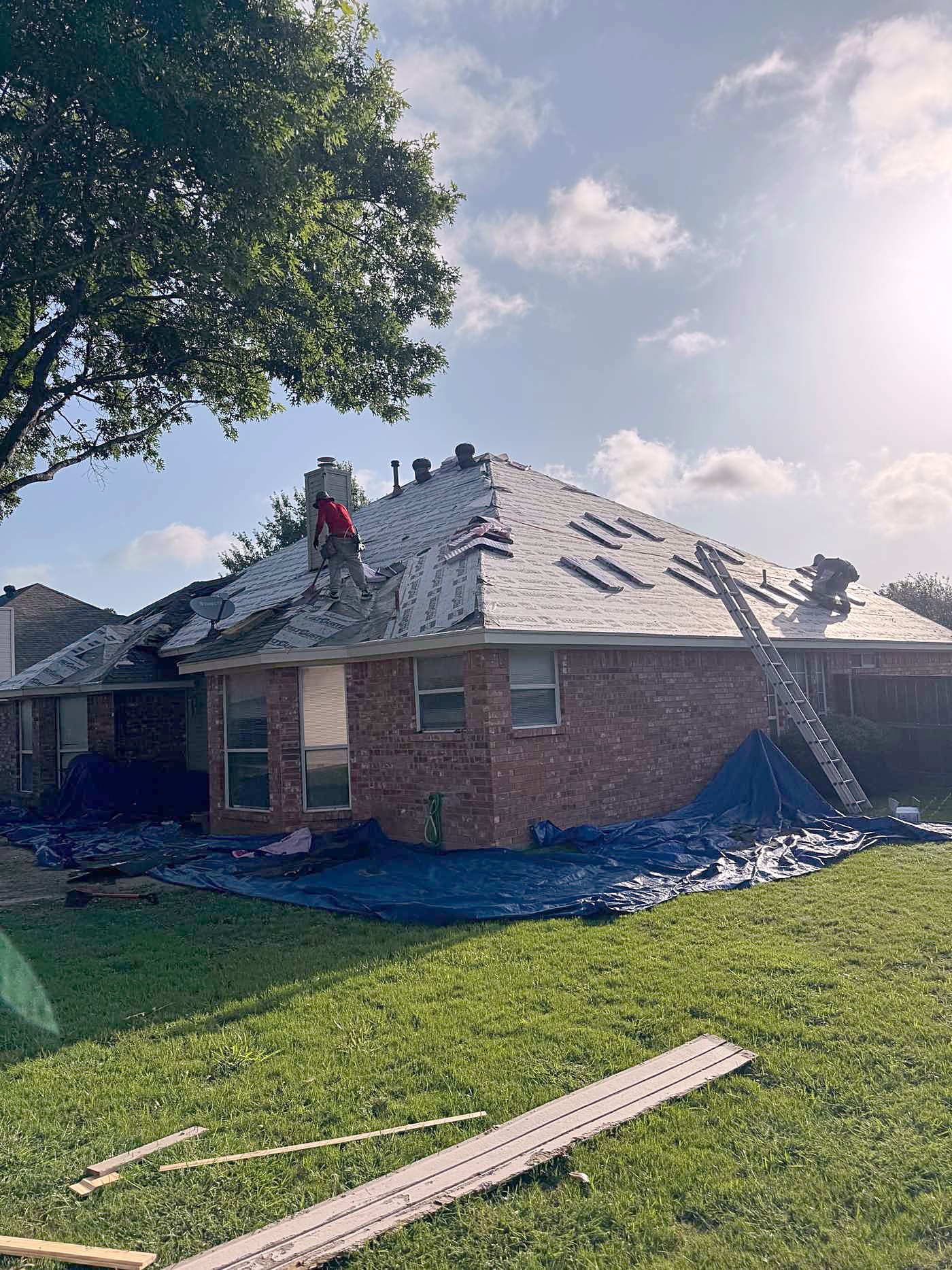
Insurance
What this work covers on a Fort Worth roof.
A roof claim in Texas has two sides, and it helps to know which side a roofer is on. Only a licensed public adjuster can negotiate your claim for you or represent you in a dispute with your insurance company, and Texas law does not allow a contractor to take that role. Our part is the roof. We inspect it, document the storm damage with photos and a written scope, meet your carrier's adjuster at the roof if you want us there, and build the new roof to the scope your carrier approves. The claim stays between you and your insurance company the whole way through. What follows is the usual order of a Texas roof claim, so you know what is coming and what each piece of paper means when it arrives.
The first step comes before the phone call to your carrier. A free inspection tells you whether the roof has storm damage worth claiming, and it gives you the date of the storm and a description of the damage to work from. You file the claim with your carrier directly, by phone, app or through your agent, and you will get a claim number to use on everything that follows. This is also the time to look up your deductible. Many Texas policies set a separate wind and hail deductible as a percentage of the home's dwelling coverage, often 1 or 2 percent, so on a house insured for $350,000 a 2 percent deductible comes to $7,000. The deductible is yours to pay, and a contractor who offers to waive, cover or rebate it is breaking Texas law under Insurance Code Chapter 707.
How It Works
Inspection
We inspect the roof to find the damage and what is causing it.
Estimate
You get a repair plan or a replacement scope with a clear estimate.
The work
We protect the property, check the decking and install the materials you chose.
Final inspection
We clean up the property and inspect the finished roof before we call it done.
The Difference
Worth knowing before the inspection.
Texas gives carriers set time frames under the prompt payment rules in Insurance Code Chapter 542. In general, your carrier has 15 days after you report the claim to acknowledge it, start its investigation and ask for anything it needs from you. Once it has everything it asked for, it generally has 15 business days to accept or deny the claim, with up to 45 days if it tells you why it needs more time, and extra time is allowed after a declared weather catastrophe. Somewhere in that stretch, an adjuster inspects the roof. The adjuster works for the carrier, or for a firm the carrier hired, and their job is to measure the roof and record the damage. If you would like us at the roof during that visit, we can walk it with the adjuster and point out the damage we documented.
After the inspection, the adjuster writes a scope and an estimate, usually as a long list of line items. A roof estimate typically covers tearing off the old shingles, underlayment, drip edge, starter strip, the shingles themselves, ridge cap, vents, pipe boots and flashing, each priced by quantity. Read it slowly. The measurements should match the size of the roof, the pitch affects labor, and a second layer of old shingles or a detached garage should appear if the house has them. We compare the adjuster's scope with what we found on the roof, and we build to the scope your carrier approves. If the two do not line up, that is the point where a supplement comes in, and it is far easier to raise before the work starts than after it is finished.
Most payment confusion comes from the difference between replacement cost and actual cash value. On a replacement cost policy, the carrier usually pays in two parts. The first check is the actual cash value: the full replacement cost, minus depreciation for the age of the roof, minus your deductible. The depreciation is held back until the work is done and the final invoice is sent to the carrier. As an example, on an $18,000 replacement with $5,000 of depreciation and a $3,500 deductible, the first check would be $9,500 and the remaining $5,000 would follow after completion, which leaves your deductible as the part you pay. An actual cash value policy stops at the first check. Some policies settle older roofs this way, so check which kind yours is. Checks often name your mortgage company too, and it has to endorse them before the money can be used.
Adjusters work quickly after a big storm, and items get missed. A supplement is a request to the carrier to add work that the original scope left out or that nobody could see until the old roof came off. Common ones are drip edge or starter strip missing from the estimate, a second layer of shingles under the first, decking that turns out to be rotten or damaged once it is exposed, and items that local building code requires on a new roof. For each one, we provide photos and the line items for what was missed, and your carrier reviews them and decides whether to add them to the claim. A supplement is never guaranteed, and the carrier makes the call, but a well documented request with clear photos gives the adjuster what they need to review it fairly.
Deadlines run through every stage of a claim, and they vary by policy. Your policy sets how long you have to report storm damage, and many also set a time limit for finishing the work and claiming the depreciation held back from the first check. Find the conditions section of your policy and read it, or ask your agent to walk you through it. If the carrier denies the claim or the scope looks short, you can ask for a re-inspection, and many Texas policies include an appraisal clause for disputes over the amount of a loss. The Texas Department of Insurance also takes consumer complaints. For the roof itself, the first step is the same: call (817) 988-9509 or send the form, and we will set up a free inspection.
Get a Free EstimateBefore You Call
Insurance, answered.
Will you handle my insurance claim for me?
We help with the roof side of it, and the claim itself stays between you and your carrier. We inspect, document the damage with photos and a scope, meet the adjuster at the roof if you want, and build to the approved scope. Texas law reserves negotiating a claim on your behalf for licensed public adjusters.
Do I have to pay my deductible?
Yes. The deductible is the homeowner's share under Texas law, and a contractor offering to waive, absorb or rebate it is violating Insurance Code Chapter 707. Your policy's declarations page shows the amount, which on many Texas policies is a percentage of dwelling coverage for wind and hail.
Why was my first insurance check less than the estimate?
On a replacement cost policy, the first check is usually the actual cash value: the estimate minus depreciation and your deductible. The depreciation is typically released after the work is finished and the final invoice goes to the carrier. An actual cash value policy does not pay that second part, so check which kind you have.
Can you guarantee my claim will be approved?
No, only your insurance carrier decides whether to approve a claim and for how much. What we can do is inspect the roof and document the damage clearly. Call (817) 988-9509 or send the form to set up a free inspection before you file.
What if the adjuster missed damage?
It can be added through a supplement, which asks the carrier to review items left out of the original scope. We provide photos and line items for what was missed, and your carrier decides whether to add them. If you disagree with the result, you can ask your carrier for a re-inspection.
Insurance
Insurance, handled from the first inspection to the final nail.
Let's work together
Get a Free Roof Inspection
Call (817) 988-9509 or send the form. We inspect the roof, tell you what we found and give you a clear estimate. No pressure, just honest answers.
Crafted Roofing LLC 16170 US-377, Fort Worth, TX 76126 (817) 988-9509 · Craftedroofingtx@