Services
Metal RoofingBased in Fort Worth, TX
Standing seam and exposed-fastener metal roofs for homes and businesses, and repair for the metal roof you already have.
Get a Free Estimate
Metal
What this work covers on a Fort Worth roof.
A metal roof is one of the few roofing choices in North Texas that can outlast the mortgage. A well-installed steel roof commonly lasts 40 to 70 years, where an asphalt shingle roof in this climate usually gives 15 to 25, and metal has no granules for the sun to strip away and no edges to curl after a few hot summers. We install metal roofing on homes and on commercial buildings, including large industrial ones, and the free estimate is where we work out which kind of metal roof suits yours. There are two broad families, standing seam and exposed-fastener panels. They look different from the street, but the real difference is how each one is fastened to the roof, and that one detail drives both the price and how much attention the roof needs over its life.
Standing seam is the metal roof most people picture on a modern farmhouse or a Hill Country home. The panels run from ridge to eave in one piece, and the seams between them stand an inch or more above the flat of the roof. The fasteners sit under those raised seams, attached to the deck with clips, so no screw passes through the part of the panel that water runs across. The clips also let each panel slide slightly as it expands in afternoon heat and shrinks back overnight, which matters on a roof whose surface temperature can swing sixty degrees in a day. With no exposed screws to back out and no washers to dry up, a standing seam roof asks for very little upkeep once it is on, and that is most of what the higher price buys.
How It Works
Inspection
We inspect the roof to find the damage and what is causing it.
Estimate
You get a repair plan or a replacement scope with a clear estimate.
The work
We protect the property, check the decking and install the materials you chose.
Final inspection
We clean up the property and inspect the finished roof before we call it done.
The Difference
Worth knowing before the inspection.
Exposed-fastener panels, often sold as R-panel or PBR panel, are the ribbed sheets you see on barns and shop buildings across the country west of Fort Worth. The panels overlap one another and are screwed straight through the face into the framing or deck, with a rubber washer under each screw head sealing the hole. They cost considerably less than standing seam and go on faster, which makes them a sensible choice for outbuildings, warehouses, carports and homes on a tighter budget. The weak point is those washers. Years of sun dry them out, and the panel's daily expansion slowly works the screws loose, so an exposed-fastener roof needs its screws checked, and some of them replaced, every ten to fifteen years. When that is skipped, the leaks start at the screw holes.
Metal handles a Fort Worth summer better than its reputation suggests. Modern panels carry factory paint finishes, the better ones based on PVDF resin and sold under names like Kynar 500, that hold their color for decades and reflect a good share of the sun. A light or cool-rated color cuts the heat the roof passes into the attic, and even darker metal sheds its heat quickly after sunset because it has so little mass to store it. The steel underneath is usually Galvalume, coated with an aluminum and zinc alloy that resists rust far longer than plain galvanized steel. Aluminum panels exist too, and they mostly earn their extra cost near salt air. Inland in Tarrant County, coated steel does the job for less money.
Hail is the first question most North Texas homeowners ask about metal. Metal does not crack or shed granules when hail hits it, and many panels carry a Class 4 impact rating under UL 2218, the highest rating that test gives. What large hail can do is dent it. Most dents are cosmetic, meaning the panel still sheds water and the paint is intact, but they are visible in low sun. Thicker panels dent less, which is one reason 24 gauge is often chosen over 26 or 29 gauge in hail country, and a panel with striations or light texture hides small dents better than a smooth flat one. Read your homeowners policy before choosing metal, because some carriers discount a Class 4 roof and some policies exclude cosmetic damage to metal from coverage.
Two worries come up about metal on a house, and neither holds up well. The first is noise. Over solid decking with underlayment beneath, which is how residential metal is normally installed, rain on a metal roof sounds much like rain on shingles from inside the house, and the loud tin-roof drumming belongs to open-framed barns. The second is lightning, and a metal roof does not attract a strike any more than other roofs do. The underlayment is what deserves more thought. Under metal in Texas heat, a high-temperature synthetic underlayment holds up where ordinary felt can soften and stick to the panels. Oil canning, a slight waviness that can show in wide flat panels, is also worth asking about when choosing a profile, since striations and heavier gauges reduce it.
On commercial and industrial buildings, metal is often the roof and the building's outer skin at once. Warehouses and metal shop buildings commonly use exposed-fastener or standing seam panels over steel purlins, and as those roofs age the fasteners rust and the sealant at the panel laps dries out. Leaks around skylight panels and rooftop units usually follow. An older metal roof in that condition can often be restored with a silicone coating over re-secured fasteners, or covered with new standing seam on a retrofit framing system, without tearing the old roof off. We handle metal roofing and silicone coatings on commercial and industrial buildings, and the inspection shows which of those routes a particular roof is suited to and what each would cost.
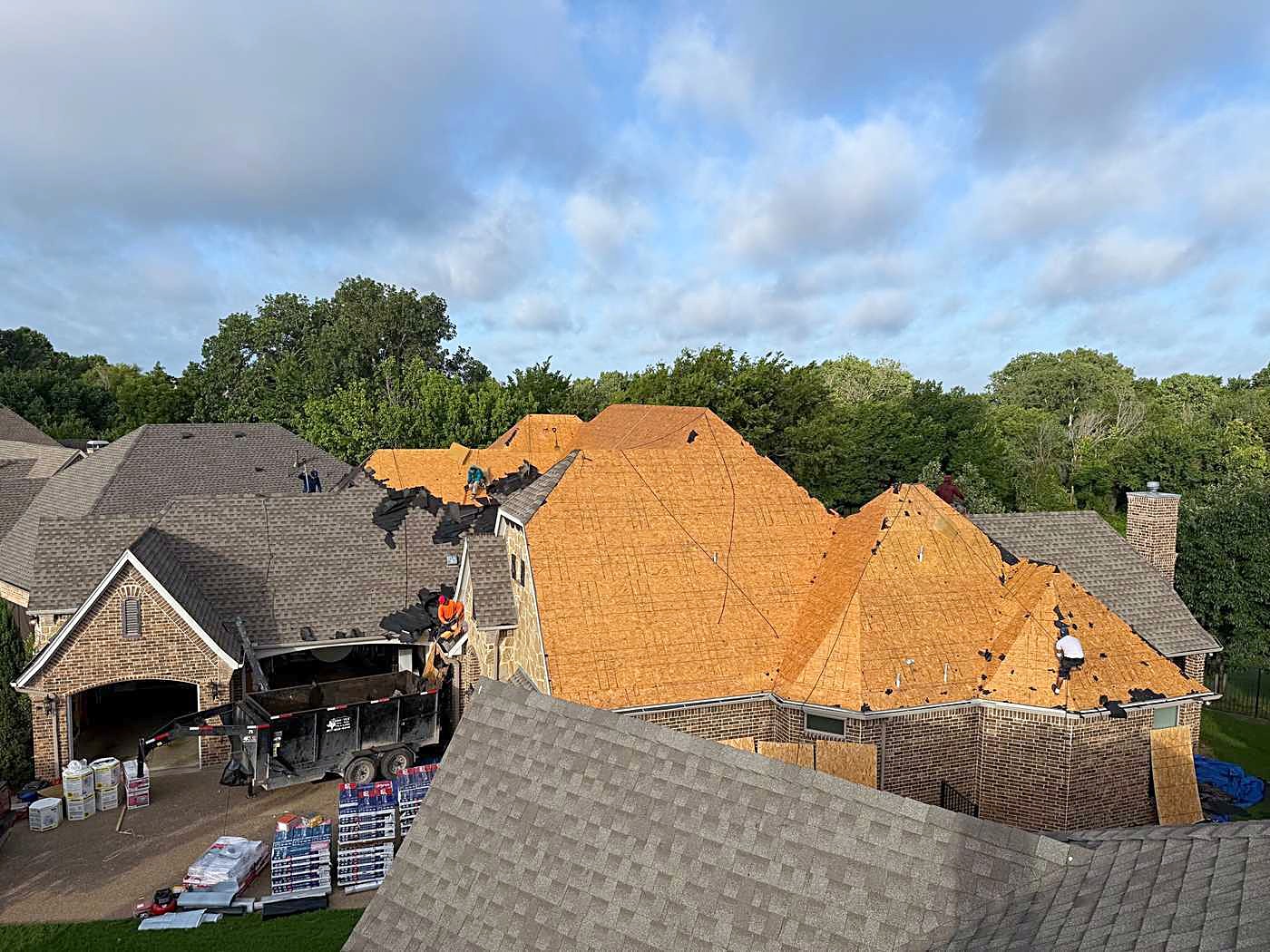
Replacing a roof with metal follows the same sequence as any replacement we do. It starts with a consultation and a clear estimate, then prep that protects your property and a check of the deck, since a panel can only be as flat and secure as the surface it is fastened to. You choose the panel profile and color, the roof goes on, and the job finishes with clean-up and a final inspection. Metal roofs that are already on a building get repaired too, whether the trouble is backed-out screws on an older panel roof or a leaking flashing where the metal meets a wall or chimney. Call (817) 988-9509 or send the form for a free estimate on a new metal roof or a repair to the one you have.
Get a Free EstimateBefore You Call
Metal, answered.
How long does a metal roof last in Texas?
A standing seam steel roof commonly lasts 40 to 70 years, and exposed-fastener panels can go 30 to 50 years if their screws are maintained. The paint finish, the gauge and the quality of the flashing work decide where in that range a particular roof lands.
Is a metal roof worth the cost over shingles?
Often, if you plan to stay in the house a long time. Standing seam typically costs two to three times as much as an architectural shingle roof, a range you can check against any local quote, but it can outlast two or three shingle roofs. For a home you may sell in a few years the math is closer, and we can price both options at the same free estimate.
Will hail dent a metal roof?
Large hail can dent it, though most dents are cosmetic and the roof keeps shedding water. Thicker 24-gauge panels and textured profiles dent less, and many metal roofs carry a Class 4 impact rating. Check whether your policy excludes cosmetic damage to metal before you choose.
Is a metal roof loud when it rains?
Very little over a solid deck. Installed over decking and underlayment the way homes are roofed, rain on metal sounds close to rain on shingles from inside the house.
Can you repair my existing metal roof?
Yes, metal roof repair is part of our work, from backed-out screws on panel roofs to leaking flashing at walls and chimneys. Call (817) 988-9509 or send the form to set up a free inspection.
Metal
Metal, handled from the first inspection to the final nail.
Let's work together
Get a Free Roof Inspection
Call (817) 988-9509 or send the form. We inspect the roof, tell you what we found and give you a clear estimate. No pressure, just honest answers.
Crafted Roofing LLC 16170 US-377, Fort Worth, TX 76126 (817) 988-9509 · Craftedroofingtx@